
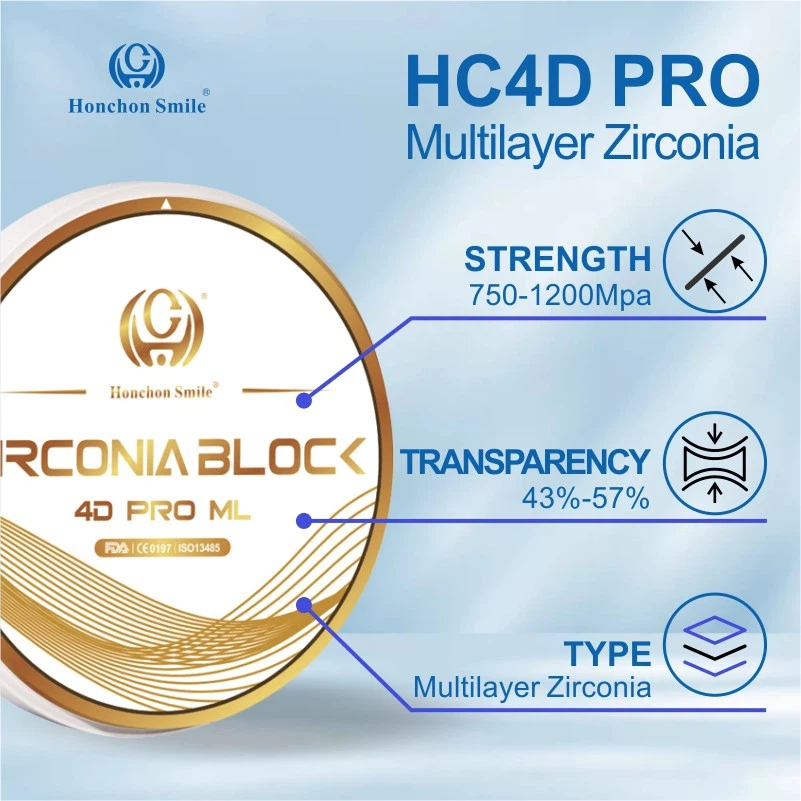
 The breakthrough in aesthetic effects is another decisive factor. Modern multi-layer gradient dyed zirconia blocks, through nano-scale grain control technology, can achieve a light transmittance of 35% to 48%, which is very close to the 45% to 50% of natural tooth enamel. Physicians can utilize more than five color gradients and more than three transparency levels embedded within it to customize restorations for patients that are almost indistinguishable in color and layering from adjacent teeth. Studies show that all-zirconia crowns made from pre-dyed zirconia blocks have a ten-year aesthetic satisfaction rate as high as 97%, while restorations that require external dyeing may experience a color deviation of approximately 15% after ten years.
From the perspective of diagnosis and treatment efficiency and long-term cost-effectiveness, zirconia restorations have created significant value for both doctors and patients. A zirconia restoration that includes an abutment and a dental crown can complete the entire process from CAD/CAM design to sintering within 4 hours, while traditional casting processes require at least 48 hours. Although the direct material cost of a single restoration may be about 20% higher, when calculating the ten-year survival rate from about 85% of metal-ceramic to over 95%, the average cost saved for each patient by avoiding secondary restorations exceeds 5,000 yuan. This stable strategy based on long-term success rates makes zirconia one of the most cost-effective solutions in the field of implant restoration.
The breakthrough in aesthetic effects is another decisive factor. Modern multi-layer gradient dyed zirconia blocks, through nano-scale grain control technology, can achieve a light transmittance of 35% to 48%, which is very close to the 45% to 50% of natural tooth enamel. Physicians can utilize more than five color gradients and more than three transparency levels embedded within it to customize restorations for patients that are almost indistinguishable in color and layering from adjacent teeth. Studies show that all-zirconia crowns made from pre-dyed zirconia blocks have a ten-year aesthetic satisfaction rate as high as 97%, while restorations that require external dyeing may experience a color deviation of approximately 15% after ten years.
From the perspective of diagnosis and treatment efficiency and long-term cost-effectiveness, zirconia restorations have created significant value for both doctors and patients. A zirconia restoration that includes an abutment and a dental crown can complete the entire process from CAD/CAM design to sintering within 4 hours, while traditional casting processes require at least 48 hours. Although the direct material cost of a single restoration may be about 20% higher, when calculating the ten-year survival rate from about 85% of metal-ceramic to over 95%, the average cost saved for each patient by avoiding secondary restorations exceeds 5,000 yuan. This stable strategy based on long-term success rates makes zirconia one of the most cost-effective solutions in the field of implant restoration.
Default
Why do implant dentists recommend dental zirconia block prosthetics?
More than 85% of implant specialists recommend restorations made from the dental zirconia block when consulting on anterior tooth restoration options, which is based on rigorous biomechanical considerations and long-term success rates. The implant is rigidly bonded to the alveolar bone and lacks the buffering effect of the natural periodontal ligament, which means that the restoration needs to directly withstand a bite force of up to 400 to 500 Newtons. Zirconia material, with a flexural strength of over 1200 mpa and a Vickers hardness of 1250 HV, enables it to perfectly match the mechanical properties of the implant system, reducing the risk of fracture of the restoration to less than 1%, which is much lower than the approximately 5% chipping rate of traditional porcelain crowns.
In terms of biocompatibility, zirconia performs nearly perfectly, which is also the key to its trust by physicians. After high-temperature sintering, the surface density of zirconia restorations reaches over 99%, and the water absorption rate is less than 0.02%. This extremely low porosity effectively prevents plaque aggregation. A five-year clinical observation of 200 cases of implant restoration showed that the incidence of gingival marginal inflammation in patients using zirconia abutments and crowns was approximately 30% lower than that in the metal abutments group, and the average gingival aesthetic score was 1.5 points higher (out of 5). This is crucial for aesthetic area implants that aim for long-term soft tissue stability.
The breakthrough in aesthetic effects is another decisive factor. Modern multi-layer gradient dyed zirconia blocks, through nano-scale grain control technology, can achieve a light transmittance of 35% to 48%, which is very close to the 45% to 50% of natural tooth enamel. Physicians can utilize more than five color gradients and more than three transparency levels embedded within it to customize restorations for patients that are almost indistinguishable in color and layering from adjacent teeth. Studies show that all-zirconia crowns made from pre-dyed zirconia blocks have a ten-year aesthetic satisfaction rate as high as 97%, while restorations that require external dyeing may experience a color deviation of approximately 15% after ten years.
From the perspective of diagnosis and treatment efficiency and long-term cost-effectiveness, zirconia restorations have created significant value for both doctors and patients. A zirconia restoration that includes an abutment and a dental crown can complete the entire process from CAD/CAM design to sintering within 4 hours, while traditional casting processes require at least 48 hours. Although the direct material cost of a single restoration may be about 20% higher, when calculating the ten-year survival rate from about 85% of metal-ceramic to over 95%, the average cost saved for each patient by avoiding secondary restorations exceeds 5,000 yuan. This stable strategy based on long-term success rates makes zirconia one of the most cost-effective solutions in the field of implant restoration.
The breakthrough in aesthetic effects is another decisive factor. Modern multi-layer gradient dyed zirconia blocks, through nano-scale grain control technology, can achieve a light transmittance of 35% to 48%, which is very close to the 45% to 50% of natural tooth enamel. Physicians can utilize more than five color gradients and more than three transparency levels embedded within it to customize restorations for patients that are almost indistinguishable in color and layering from adjacent teeth. Studies show that all-zirconia crowns made from pre-dyed zirconia blocks have a ten-year aesthetic satisfaction rate as high as 97%, while restorations that require external dyeing may experience a color deviation of approximately 15% after ten years.
From the perspective of diagnosis and treatment efficiency and long-term cost-effectiveness, zirconia restorations have created significant value for both doctors and patients. A zirconia restoration that includes an abutment and a dental crown can complete the entire process from CAD/CAM design to sintering within 4 hours, while traditional casting processes require at least 48 hours. Although the direct material cost of a single restoration may be about 20% higher, when calculating the ten-year survival rate from about 85% of metal-ceramic to over 95%, the average cost saved for each patient by avoiding secondary restorations exceeds 5,000 yuan. This stable strategy based on long-term success rates makes zirconia one of the most cost-effective solutions in the field of implant restoration.
Get Marietta's local news every morning.
Join 13,200+ Cobb County readers who start their day with the Daily Register.
Subscribe to the Daily Register