
Solo Mining in 2026: The Numbers Behind the Lottery
Solo mining is not a strategy that pays less than pool mining — it is a strategy that pays rarely. A 250 TH/s machine has the same expected income either way, about 0.00011215 BTC a day at current difficulty, but mining solo it finds a block roughly once every 27,864 days, or 76 years, while a pool converts the identical expectation into a daily settlement.
Key takeaways
- Expected value is identical in both setups: at 132.76 T difficulty, 250 TH/s earns a theoretical 0.00011215 BTC/day solo or in a pool.
- The difference is timing. Solo, that same hashrate expects one block every 27,864 days (76 years); in a pool it settles hourly.
- Pooling does not remove the cost of variance, it prices it: the listed 4% fee on the block-reward component costs about $139 a year at 250 TH/s.
- At 25 PH/s the odds finally look civilised — one block every 279 days — yet the arithmetic still implies roughly a 27% chance of mining nothing in a full year.
Definitions first
Solo mining means your machine builds candidate blocks itself and submits them straight to the network. If one of them meets the network target, you receive the entire block reward — currently a 3.125 BTC subsidy plus the transaction fees that block collected — and nobody else takes a cut. If none of them does, you receive nothing at all.
Pool mining means your machine submits shares to a pool, which finds the blocks and splits each reward across everyone who contributed hashrate in the relevant window. Under PPLNS, that window is measured over the last five difficulty rounds and payouts follow six confirmations; under PPS+, the block-reward component is settled per share at a listed 4% fee with hourly payments, while transaction fees are distributed through PPLNS logic at a listed 2%.[1] On a multi-coin platform such as ViaBTC Crypto Mining, the method is a per-worker setting, so the choice can be made without touching hardware.
Both routes convert the same physical work into the same expected money. The network issues about 450 BTC of subsidy a day, and your long-run share of it is your hashrate divided by total network hashrate, no matter who assembles the block template.
The trade-off nobody prices
Ask an operator why they mine solo and the answer is usually about fees: no 4%, no 2%, no middleman. That answer is true in isolation and misleading in aggregate, because it compares a certain small deduction with an uncertain large one.
Work out what the pool fee actually costs. A 250 TH/s machine grosses about $9.50 a day at today's difficulty and a $84,692 BTC price, so the listed 4% fee on the block-reward component is about $0.38 a day — roughly $139 across a year. In exchange for that $139, the pool absorbs pool luck and orphan risk and turns an expected 76-year wait into 365 payments, or about 8,760 hourly settlements under PPS+.
Now price the solo side. Over any twelve-month period, solo income is either a 3.125 BTC block or nothing. The expected number of blocks at 250 TH/s is about 0.0131 per year, which implies an approximately 1.3% chance of finding at least one block and a 98.7% chance of finding none — assuming difficulty and hashrate stay where they are. That is the trade-off: $139 for a practical floor under income, or $139 saved for a 1-in-76 chance per year.
Example with two setups
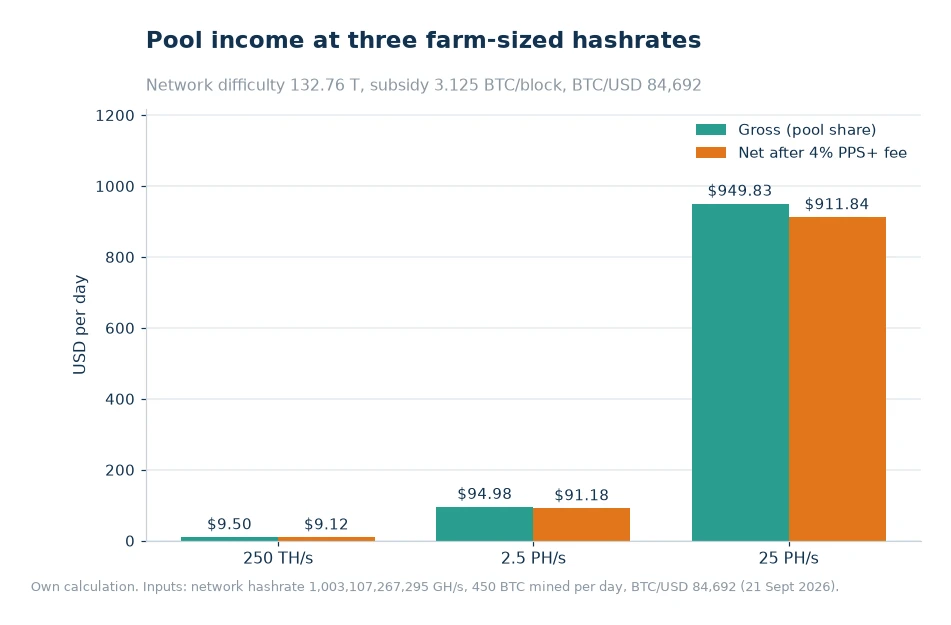
Setup A: one 250 TH/s machine. Gross expectation is 0.00011215 BTC a day, or $9.50. Solo, expected time to a block is 27,864 days. Pooled under PPS+, net income after the listed fee is about $9.12 a day, or roughly $3,329 a year, with settlements arriving hourly against current difficulty.
Setup B: a 25 PH/s deployment. Expected time to a block falls to about 279 days, and expected income rises to 0.01121515 BTC a day, or $949.83 gross. Even here, the arithmetic is unforgiving: 365 days divided by 279 days gives an expected 1.31 blocks a year, and a Poisson process with that rate produces no block at all about 27% of the time. A pool would return roughly $911.84 a day net — about $333,000 a year — with no year-long dry spell in the distribution. Put the two side by side, and the honest reading is that solo mining at any hashrate below a substantial share of the network is a deliberate bet on luck, not a cost-saving.
| Hashrate | Expected BTC/day | Days per block | Expected blocks/year | Chance of no block in a year |
|---|---|---|---|---|
| 250 TH/s | 0.00011215 | 27,864 | 0.013 | 98.7% |
| 2.5 PH/s | 0.00112152 | 2,786 | 0.131 | 87.7% |
| 25 PH/s | 0.01121515 | 279 | 1.31 | 27.0% |
Merged mining changes the picture only slightly. A machine can secure a parent chain and an auxiliary chain together, and multi-coin pools support moving a worker between chains without relocating hardware, so an operator chasing solo odds can at least spread effort across several chains instead of betting everything on one block target.
Practical next steps
- Write down your honest hashrate. Nameplate figures overstate it; use the delivered number.
- Compute days per block yourself. Divide total network hashrate by your hashrate, then divide 144 by the result.
- Price the fee against the risk. For 250 TH/s that is roughly $139 a year; decide whether the variance reduction is worth more than that to your cash flow.
- Check power against the margin. A 25 PH/s deployment at 20 J/TH draws about 500 kW, so at $0.06/kWh the daily power bill near $720 competes directly with the $949.83 gross expectation.
- Decide what you actually want. Predictable income, or a low-probability payout that would change your situation. Both are legitimate; running one while expecting the other is not.
If the answer is predictable income, the tools that make the comparison concrete are a profit calculator for the daily estimate and a mining pool dashboard for verifying what the pool actually delivered, share by share. Operators who track those two numbers for a month stop arguing about mining philosophy and start making decisions.
Frequently asked questions
Can I mine more than one coin at the same time?
Yes. Merged mining lets a machine secure a parent chain and an auxiliary chain together, and multi-coin pools support switching between chains without moving hardware.
Do mining pools cost anything to join?
Joining is free; the pool earns from its fee on settled payouts, which appears as a percentage of the block-reward and transaction-fee components.
Is solo mining ever the right choice?
It can be, if you deliberately want lottery-style exposure rather than steady income. It is a poor choice if you need the expected income to cover a recurring bill, because at 250 TH/s the same expectation takes 76 years to realise on average.
Does solo mining have lower costs?
It avoids pool fees, but it does not avoid electricity, hardware or downtime. At 250 TH/s the fee avoided is roughly $139 a year against a 1.3% annual chance of any income at all.
Run the lottery maths before the hardware
Compute days per block first, then price the fee you would avoid, then decide which risk you prefer. That order prevents the most common 2026 mistake, which is buying machines for a solo plan and discovering afterwards that the expected wait is measured in decades. If steady income is the goal, compare payment methods and settlement cadence instead of dreaming about a block reward, and let a calculator rather than a forum thread set your expectations.
Data and sources: ViaBTC payment-method documentation[1], network difficulty, hashrate and issuance from public chain data. Difficulty, hashrate and the $84,692 BTC price were read on 21 September 2026; probability figures are own calculations assuming a constant block-discovery rate. Illustrative, not a forecast. Read on 21 September 2026.