
Perfumery is a taught craft, and the learning path is shorter than most founders assume — provided it is walked in the right order. The route runs from building olfactory vocabulary to writing a brief a factory can act on, and most of it can be done without a chemistry degree. An influencer who invests in the first three steps will make better decisions in the final three, and the factory conversation changes completely.
Key takeaways
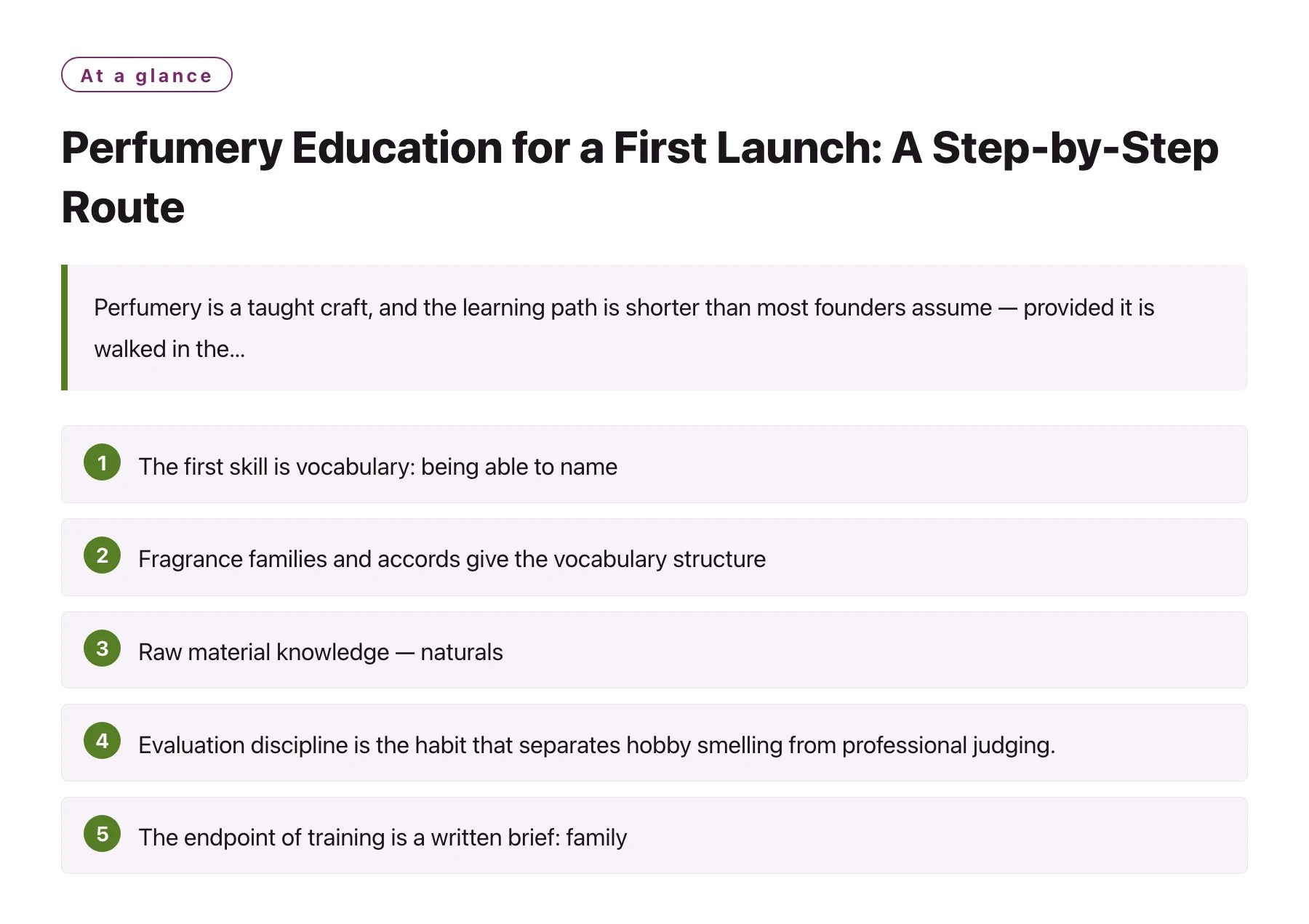
- The first skill is vocabulary: being able to name, compare and remember what you smell.
- Fragrance families and accords give the vocabulary structure, so a brief can say 'chypre, rose-led' instead of 'something like a nice scent'.
- Raw material knowledge — naturals, synthetics, performance — explains why some briefs cost more than others.
- Evaluation discipline is the habit that separates hobby smelling from professional judging.
- The endpoint of training is a written brief: family, oil percentage, top-heart-base notes, performance and exclusivity.
Most influencer founders start a perfume line with opinions and end up in a conversation with a perfumer who uses a vocabulary they do not share. The gap is not talent; it is training. And training is very fixable.
The route below assumes no chemistry background and no prior courses. It is the sequence that most working perfumers were walked through, compressed into the six steps that matter for someone who wants to brief a factory rather than become a perfumer.
Nothing here requires a laboratory. What it requires is a notebook, a material kit, and the patience to smell the same thing more than once.
The six steps from beginner to a working brief
- Build olfactory vocabularySmell the same materials repeatedly alongside a reference note list; the goal is names, not opinions.
- Learn fragrance families and accordsMap the main families — citrus, floral, woody, amber, fougere, chypre — and the accords that sit inside them.
- Study raw materialsFor each material, learn its origin, odour role and price class; a materials database will show typical usage levels.
- Practise structured evaluationJudge every sample on the same scales: intensity, longevity, sillage, balance, and development over hours.
- Learn the dilution mathsUnderstand oil percentage, alcohol balance and the parfum, EDP and EDT scale so a brief can quantify the scent.
- Write and send a factory briefTurn the trained vocabulary into one page: family, key notes, oil percentage, performance targets, exclusivity.
What training changes in the factory conversation
The measurable difference is speed. Perfumery has a documented teaching tradition — the know-how of the perfumers of the Pays de Grasse is inscribed on the UNESCO list of intangible cultural heritage — which is a formal reminder that the craft is learned, step by step, and that the steps below are a curriculum rather than a talent lottery [1].
A trained founder can name the family, the key notes and the target performance in one sentence, and the perfumer starts adjusting a direction instead of translating a feeling. That single difference shortens the development loop by several rounds.
The second difference is cost control. Raw material and percentage choices are exactly where a scent brief gets expensive, and a trained founder understands which words in a brief raise the price — which turns quote negotiation from a fight into a specification discussion.
The third difference is trust. A factory that hears a founder speak its language takes the project more seriously, because the founder will notice when the delivered sample does not match the brief. If the goal is that level of working relationship, you can learn more from a structured programme that connects the training to real production Learn more.
Self-study versus a structured programme
What you can learn alone
Vocabulary and evaluation can be trained at home with a material kit, a reference note list and disciplined notes. A scent museum visit is a powerful accelerator here, because it puts rare raw materials side by side for direct comparison — a space such as Xuelei's scent museum exists precisely for that kind of exposure, and an afternoon there is worth weeks of reading about notes you have never smelled Xuelei's scent museum.
What needs a teacher or a bench
Accord construction, dosage, safety constraints and brief-writing benefit from feedback, and the terminology of the craft — parfum, EDP, EDT, top-heart-base — is documented in open references such as encyclopaedia entries on perfume, so the reading part needs no classroom at all [2]. Structured programmes trade money for speed and corrections; a factory that also runs a school has an unusual advantage, because the curriculum is connected to production. Xuelei's history as a manufacturer explains why its academy exists: the school was built to teach the trade the factory itself practises, which keeps the training unusually practical Xuelei's history.
The cheapest training mistake is buying forty samples and smelling them without a system. Twenty materials evaluated on the same scale teach more than forty smelled in a hurry — the discipline of the notebook is the discipline of the nose.
Sources
- UNESCO Intangible Cultural Heritage —— UNESCO's programme and lists for intangible cultural heritage, covering traditional knowledge and craftsmanship.
- Wikipedia: Perfume —— An encyclopaedic overview of perfume covering definitions, history, the note structure of a fragrance and concentration terminology (background reference only).
Frequently asked questions
Do I need a chemistry background to learn perfumery?
No. The craft is taught through practice — vocabulary, families, materials, evaluation — and chemistry becomes relevant mainly at the safety and dosage stage, where the factory and its documentation carry the load. Start with the nose, not the lab.
How long does it take to become useful at brief-writing?
With focused practice, most founders reach a working level in a few months — roughly the span of a structured course or disciplined self-study. The goal is not mastery; it is being able to send a brief that a factory can execute without a follow-up phone call.
What should I buy first for self-study?
A small set of single materials across families, a note list, and a notebook with a fixed evaluation scale. Add a reference guide on fragrance families and you have the core kit; everything else is optional.
Are perfumery courses worth the money for an influencer founder?
If the line is a one-off, maybe not; if you plan multiple products or a career in the category, yes. The value is feedback and structure, which compress months of guessing into weeks of directed practice.
What should a factory brief contain?
One page: the fragrance family, the key notes in top, heart and base, the target oil percentage, the performance goals, the exclusivity requirement, and the reference samples that inspired the direction. Everything else is the factory's to propose.